
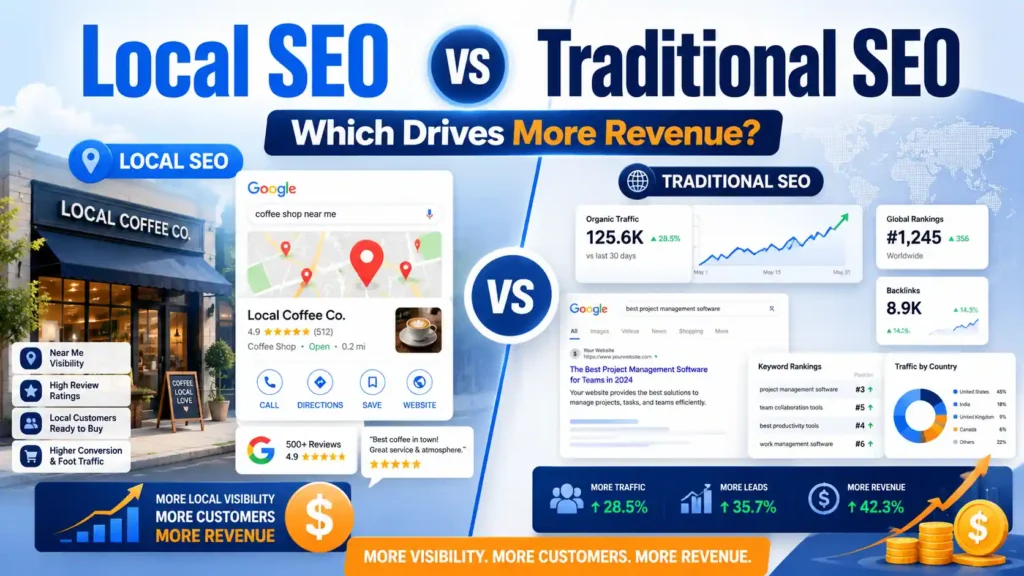
Local SEO vs Traditional SEO: What Is the Difference?
Introduction
Search engine optimization, commonly known as SEO, helps businesses improve their visibility in search engines. However, not every business has the same SEO goals.
A local business that serves customers in a specific city may need a different approach from an online business that serves customers across the country or around the world.
This is where the difference between Local SEO and Traditional SEO becomes important. Both strategies focus on improving search visibility, but they target different types of searches and audiences.
In this article, we will explain the main differences between Local SEO and Traditional SEO and why local businesses should understand both.
What Is Traditional SEO?
Traditional SEO focuses on improving a website’s visibility for relevant searches regardless of a specific physical location.
It can include activities such as:
- Keyword research
- Website optimization
- Content creation
- Technical SEO
- Internal linking
- Backlink building
- Improving website performance
For example, an online company selling software may want to rank for a broad keyword such as “project management software.”
The goal is generally to reach a wider audience through organic search results.
What Is Local SEO?
Local SEO focuses on improving a business’s visibility for searches connected to a specific geographic location.
For example, a customer might search for:
“dentist in Dallas”
or
“plumber near me.”
Local SEO helps businesses reach people who are looking for products or services in a particular area.
Key Differences Between Local SEO and Traditional SEO
1. Target Audience
Traditional SEO often targets a broad audience that can be located anywhere.
Local SEO focuses on customers in a specific city, region, or service area.
For example, an e-commerce store may target customers across the United States, while a local restaurant may focus primarily on customers in its nearby area.
2. Keyword Targeting
Traditional SEO may focus on broader keywords.
For example:
“digital marketing services”
Local SEO often uses location-based or locally relevant keywords, such as:
“digital marketing services in Houston.”
The best keywords depend on the business, its services, location, and customer search behavior.
3. Business Listings
Local SEO places greater importance on local business listings and location-related information.
Businesses need to maintain accurate information across relevant online platforms and directories.
Traditional SEO can also benefit from business information and backlinks, but local search optimization has a stronger geographic focus.
4. Location Signals
Location is a major part of Local SEO.
Search engines use different signals to understand the relationship between a business and a user’s local search. Business address, service areas, local content, and other location-related information can all be relevant.
Traditional SEO generally has less emphasis on geographic targeting.
Which Businesses Need Local SEO?
Local SEO can be especially useful for businesses that serve customers in specific locations.
Examples include:
- Restaurants
- Dentists
- Plumbers
- Roofing companies
- Salons
- Gyms
- Cleaning companies
- Local marketing agencies
- Real estate businesses
If customers need to visit a physical location or hire a business within a particular service area, Local SEO can be especially valuable.
Can a Business Use Both SEO and Local SEO?
Yes. In fact, many businesses can benefit from using both approaches.
For example, a local digital marketing agency can optimize its website for general SEO while also creating location-focused pages and content to attract customers from its target city.
Traditional SEO can help improve the overall strength and visibility of a website, while Local SEO can help the business reach customers in specific geographic areas.

How to Choose the Right SEO Strategy
The right strategy depends on your business model and target audience.
Ask yourself:
- Do I serve customers in a specific location?
- Do customers visit my physical business?
- Do I provide services within specific cities or areas?
- Are people searching for my services locally?
If the answer is yes, Local SEO should be an important part of your digital marketing strategy.
Final Thoughts
Local SEO and Traditional SEO share many basic principles, but they have different goals. Traditional SEO generally focuses on broader search visibility, while Local SEO focuses on connecting businesses with customers in specific geographic areas.
For small and location-based businesses, combining a strong website with an effective Local SEO strategy can help improve online visibility and create more opportunities to reach potential customers.
Understanding the difference between these two approaches allows businesses to choose SEO strategies that match their goals, services, and target audience.
Frequently Asked Questions
What is the main difference between Local SEO and Traditional SEO?
Traditional SEO generally targets broader search visibility, while Local SEO focuses on searches connected to a specific location.
Is Local SEO only for businesses with physical stores?
No. Service-area businesses such as plumbers, roofers, cleaners, and other professionals can also benefit from Local SEO.
Can I use Local SEO and Traditional SEO together?
Yes. Many businesses use both strategies to improve their overall search visibility while targeting customers in specific locations.
Which SEO strategy is better for a local business?
For a business that serves a specific geographic area, Local SEO is usually an important part of its overall SEO strategy. The exact approach depends on the business, competition, services, and target customers.